How Nonprofits + Schools Can Unlock Workplace Giving Funds
What is workplace giving for nonprofits? At its core, workplace giving is a type of company-sponsored program that allows employees to support their favorite nonprofits through payroll deductions, matching gifts, volunteer grants, and more.
For fundraising and higher education teams, tapping into this multi-billion dollar revenue stream requires a two-part strategy:
- The Technical Foundation: Verifying and claiming your organization's digital profiles on major corporate aggregator platforms.
- The Proactive Promotion: Actively driving donor awareness and integrating workplace giving into your daily fundraising workflows.
Executive Summary: Moving from Passive to Proactive
Every year, between $4 billion and $7 billion in corporate matching gift and workplace giving funds go completely unclaimed. This massive “underutilization gap” doesn't exist because corporate partners don't care, or because donors don't want to help. It exists because the process is often treated as an afterthought.
The good news is that leadership teams are waking up to this opportunity. Double the Donation’s recent Nonprofit Corporate Engagement Report shows that 51.1% of nonprofit professionals say their leadership is now fully invested in securing the resources needed for successful workplace fundraising.
But investment without action won't close the gap. To truly scale your revenue, your organization must shift its mindset:
The Passive Recipient (Leaving Money on the Table)
The Active Strategist (Unlocking Growth)
The Bottom Line: CSR portal verification gets you in the game, but a proactive strategy is what wins it. This guide will show you how to stop waiting for funding to show up and start intentionally bringing it in.
How Workplace Giving Works: The Modern Corporate Ecosystem
The workplace giving landscape has undergone a major shift over the last few years. Historically, corporate giving has been restricted to supporting a few pre-selected charities during a once-a-year campaign. Today, the ecosystem has evolved into a year-round, decentralized “open choice” model driven by individual team member involvement.
What are open choice workplace giving programs?
Under the open choice model, corporations let their employees decide exactly where corporate philanthropic dollars go. As long as your organization is a verified 501(c)(3) or qualifying education institution, any employee (sometimes including part-time and retired staff, too) can direct corporate funds to your mission. That’s even if you don't have a formal partnership with that company!
The 3 Pillars of Workplace Giving
Workplace giving programs can take many forms, but most companies center their employee-led philanthropy in these three program types.
Matching Gifts
When an individual donor makes a financial contribution, their employer mirrors that gift (often 1:1 or 2:1). According to the Nonprofit Corporate Engagement Report, 41.2% of nonprofits identify matching gifts as their most underutilized workplace giving revenue source.
Volunteer Grants (“Dollars for Doers”)
These are corporate grants paid to a nonprofit in recognition of volunteer hours logged by an employee. Double the Donation’s Corporate Volunteer Procurement Report revealed that 60% of nonprofits cite a lack of volunteer awareness as their biggest hurdle to capturing these funds.
Payroll Deduction
This program allows employees to set up recurring, predictable donations taken directly out of their paychecks. Data from Double the Donation, shows that 40% of nonprofit professionals view mid-level giving expansion via payroll as a top growth opportunity for annual revenue.
The Stakeholder Map: Following the Money
To be a proactive strategist, it helps to see how a single donation travels from a donor's keyboard to your bank account. While it can vary by company, the modern workplace giving pipeline generally looks something like this:
- The Supporter: The individual donor or volunteer who makes the initial gift or logs their volunteer hours.
- The Corporation: The employer or business entity providing the matching funds or volunteer grant budget.
- The TPA (Third-Party Administrator) or CSR Platform: The tech platforms (like Benevity, YourCause, or CyberGrants) that corporations use to manage their CSR programs, verify your eligibility, and distribute the actual funds.
- The Nonprofit: Your team, receiving the combined disbursements and putting them to work for your mission.
Calculating Your Organization's Workplace Giving Potential
Many organizations treat corporate matching gifts and volunteer grants as “bonus” funding. To become an active strategist, you must shift your perspective and view it as a predictable, trackable revenue stream. As a baseline, nonprofits should estimate their workplace giving potential to be 10% to 15% of their individual donor base.
If you aren't hitting that benchmark, it means you have an underutilization gap, or money that rightfully belongs to your mission but is currently being left on the table.
The Three Levers of Corporate Eligibility
Rather than relying on vague national averages, you can proactively evaluate your specific donor base using three distinct “levers” of corporate giving eligibility.
- Geography: Is your organization located near a major metropolitan area or an established tech hub? Regional corporate headquarters naturally yield a higher density of match-eligible donors and employee volunteers.
- Donor Profession: Do your supporters primarily work in “white-collar” corporate environments, healthcare systems, or Fortune 500 companies? These industries historically maintain the most robust corporate giving programs.
- Organization Type: Higher education institutions and major medical centers often experience the highest match rates due to deeply engaged alumni networks and active corporate board involvement.
The more these levers apply to your network, the higher your potential revenue percentage will be.
The “Underutilization” Gap: Don’t Miss the Moment
The single biggest reason nonprofits fail to achieve their workplace giving potential is a lack of proactive follow-up. Most organizations miss out on matching funds because they don't identify supporters’ eligibility or trigger outreach based on employment data when the individual is most likely to act.
Case Study: Letters to a Pre-Scientist
By shifting from a passive approach to a proactive, automated outreach strategy during the moment of highest intent, Letters to a Pre-Scientist scaled its corporate matching gift revenue by 3.5x. The nonprofit jumped from $7.2K to $25.3K in just eight months!
Navigating Corporate Social Responsibility Portals
CSR portals (such as Benevity, YourCause, and CyberGrants) serve as the digital gatekeepers for corporate giving. When an employee wants to request a matching gift or log their volunteer hours, they use their employer's Corporate Social Responsibility platform to complete a brief online form.
From there, CSR portals facilitate the corporate review and verification processes, then aggregate individual employee donations into consolidated disbursements for nonprofits like yours.
For your organization, being a passive recipient means waiting around and hoping a portal has your correct information on file. Being an active strategist means proactively claiming your digital profiles on these platforms to ensure your fund delivery is seamless and secure.
Understanding the Big Three Corporate Giving Platforms
While there are many corporate software options on the market, three dominant platforms handle the vast majority of funds:
Benevity
Heavily utilized by massive tech companies and global enterprises. Proactively registering here is essential for capturing modern corporate matches.
YourCause (by Blackbaud)
Frequently chosen by Fortune 500 firms. Accessing this portal allows you to see deep donor details that are often missing from standard bulk check stubs.
CyberGrants (now a part of Bonterra)
Primarily used by legacy enterprises, financial institutions, and large-scale manufacturing firms.
⚠️ The Risk of the Unclaimed Profile: If your organization’s profile is unclaimed or outdated on these platforms, you risk delayed payments, missing donor data, or corporate checks being mailed to incorrect administrative addresses.
Claiming Your Identity: The “Must-Do” Checklist
To make sure your organization is visible on these platforms (and eligible to receive funds), your development team must complete the following CSR platform setup routine:
- Claim Your Candid (GuideStar) Profile First: Most CSR portals pull their foundational nonprofit data directly from Candid. If your Employer Identification Number (EIN), legal address, or mission statement is missing or incorrect within Candid, it will be missing or incorrect across the entire corporate ecosystem. Plus, earning a Candid “Seal of Transparency” signals immediate trust to corporate funders.
- Register with the Benevity Causes Portal: Create your account and prioritize setting up Electronic Fund Transfers (EFT). Direct deposit completely bypasses mailroom delays.
- Access YourCause NPOconnect: Secure your administrator login so you can track real-time employee giving metrics and retrieve specific donor names.
- Verify Your Status on CyberGrants/Bonterra: Ensure your compliance paperwork is up to date, especially if you have local corporate manufacturing plants or financial hubs in your area.
- Ensure You’re Listed on CLMA Platforms: Double the Donation’s Certified Leader in Matching Automation designation unlocks seamless, one-click auto-submission. When your organization is registered with specific platforms like Givinga, Selflessly, Uncommon Giving, and more, eligible donors can complete their matching gift requests directly from your confirmation page.
Proactively Marketing Workplace Giving, Program by Program
Marketing workplace giving is key to growing your nonprofit’s revenue and overcoming supporter awareness gaps. With some simple workplace giving marketing, you can significantly boost revenue and tap into a new, diversified revenue source. We’ll walk through how to market and promote each program to fuel your growth.
Integrating Matching Gifts Across the Donor Journey
Increasing your corporate matching gift revenue is not achieved by running an isolated annual email campaign. It requires an active, intentional strategy that integrates matching gift visibility into every stage of the donor journey. By embedding eligibility tools directly into your donation processes and automating your follow-up sequences, your team can easily bridge the visibility gap that prevents well-intentioned donors from doubling their impact.
More importantly, an active strategist knows that a donor who is excited about a matching gift is prime for cross-channel growth, opening the door to introduce them to payroll deductions and volunteer grant programs.
Recent research shows that 46.7% of nonprofits struggle to maintain internal team prioritization for matching gift visibility. This “visibility gap” usually occurs when organizational leadership is fully invested in matching gifts, but the day-to-day execution treats it as an extra hurdle rather than a core fundraising component.
To move from a passive recipient to an active strategist, your team must shift from “mentioning matching gifts occasionally” to making them a natural, deeply embedded, and consistent part of your donation pages, thank-you letters, and ongoing donor communications.
Check out these three high-impact tactical frameworks to get started:
Add a matching gift search tool to your donation forms
Send matching gift touchpoints post-donation
The moment of highest intent occurs within 24 hours of a gift. Setting up an automated email that triggers immediately after their digital receipt is one of the most effective strategies for securing a match. Keep the message clear and direct:
“Did you know your company, [Employer], might turn your $100 gift into $200? Click here to start the 2-minute process.”
Incorporate matching gifts into social media campaigns
Integrating matching gift mentions into your social media campaigns is a great way to drive awareness of the programs. As one idea, consider running a “match-minute” campaign. This can consist of short, 60-second educational videos or other visual assets designed to keep workplace giving top-of-mind for your broader digital community. Use this simple framework to turn a standard social post into a high-conversion outreach asset:
- 0:00–0:10 (The Hook): “Did you know you can double your impact for [Mission Name] without spending another dime?”
- 0:10–0:40 (The Proof): Share a quick story: “Last month, a donor named Sarah gave $50. Because she works at [Company Name], they matched it, providing [Specific Outcome, e.g., 20 more meals].”
- 0:40–0:60 (The Call to Action): “Head to our link in bio to search for your employer and see if your gift qualifies for a match today!”
Recommended reading: Get the free Ultimate Guide to Marketing Matching Gifts to explore even more leading strategies!
Maximizing Volunteer Grants: Turning Service Hours into Funding
Volunteer grants, also widely known as “Dollars for Doers” programs, are corporate giving initiatives that provide monetary donations to nonprofits in recognition of volunteer service hours logged by employees.
A passive recipient lets volunteers walk out the door when their shift ends; an active strategist builds an automated workflow to consistently capture the data necessary to unlock this hidden revenue.
The Awareness Disconnect: Why the Goldmine Stays Untapped
Despite their incredible financial potential, recent research revealed that for 60% of nonprofits, a lack of volunteer awareness is the primary barrier to securing these funds. Most supporters simply do not realize that their corporate employer places a direct cash value on their volunteer time.
As a result, volunteers often feel they have finished their contribution once their shift is over. To break through this barrier, you must proactively educate supporters on two core concepts:
- The “Double Gift” Mindset: Volunteers need to be shown that logging their service hours in a corporate portal counts as an additional major financial donation to your mission. And it’s one that’s powered completely by their employer!
- The Threshold Problem: Many corporations require a minimum hourly engagement (e.g., 10 to 20 hours) before a grant is triggered. By actively tracking your volunteers' hours in your database, you can identify individuals who are nearing these benchmarks and prompt them to finish the final hours needed to unlock a corporate payout.
A passive recipient lets these individuals walk out the door; an active strategist builds an automated workflow to consistently capture the data necessary to unlock this hidden revenue.
Engagement Strategy: The “Automated Reminder” Loop
To maximize volunteer grant revenue, you must integrate the “ask” directly into the volunteer experience at the moment of highest engagement. We recommend the following three-step communication loop:
- Registration Form Activation: Collect employer information during your initial volunteer sign-up process. This allows you to identify corporate eligibility for grants and Volunteer Time Off programs before the individual ever arrives for a shift.
- The Confirmation Email: Send an automated “Dollars for Doers” follow-up immediately after a shift is registered for or completed. Provide company-specific next steps for those with known employers, and direct supporters to eligibility search tools if their status remains unknown.
- The Sign-In Sheet Safety Net: Use digital or paper sign-in sheets at live events to capture employer names from walk-in volunteers. This data ensures your team can run targeted follow-up email campaigns after the event.
Unlocking High-Value Grants Through Skills-Based Volunteering
Skills-based volunteering involves pro-bono professional work (such as accounting, legal counsel, or marketing strategy) performed by corporate professionals for your organization. This form of service is highly valued by CSR managers and frequently triggers significantly larger grant amounts.
When seeking specialized pro-bono support, your marketing and communications should explicitly state: “This role is eligible for corporate volunteer grants at most major firms.” This proactively incentivizes professional engagement by showing volunteers how to maximize their impact.
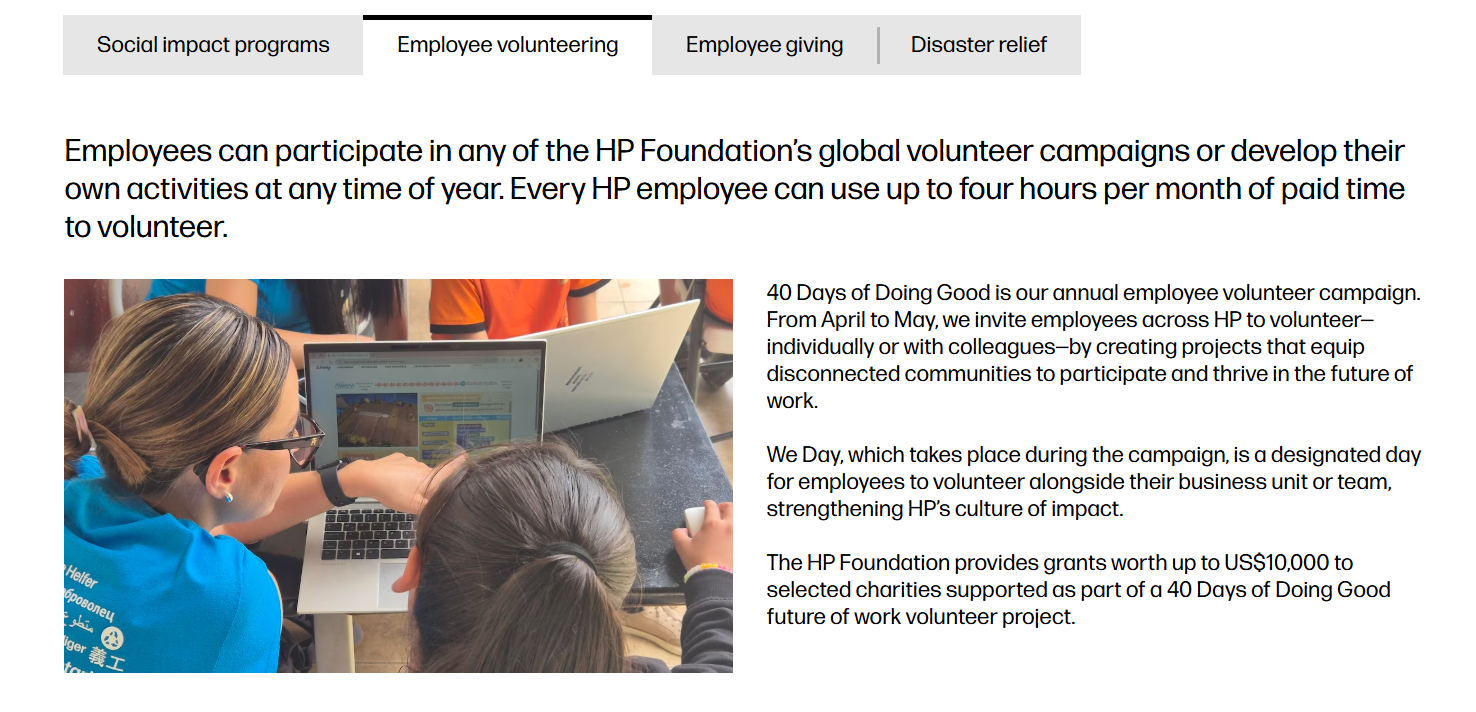
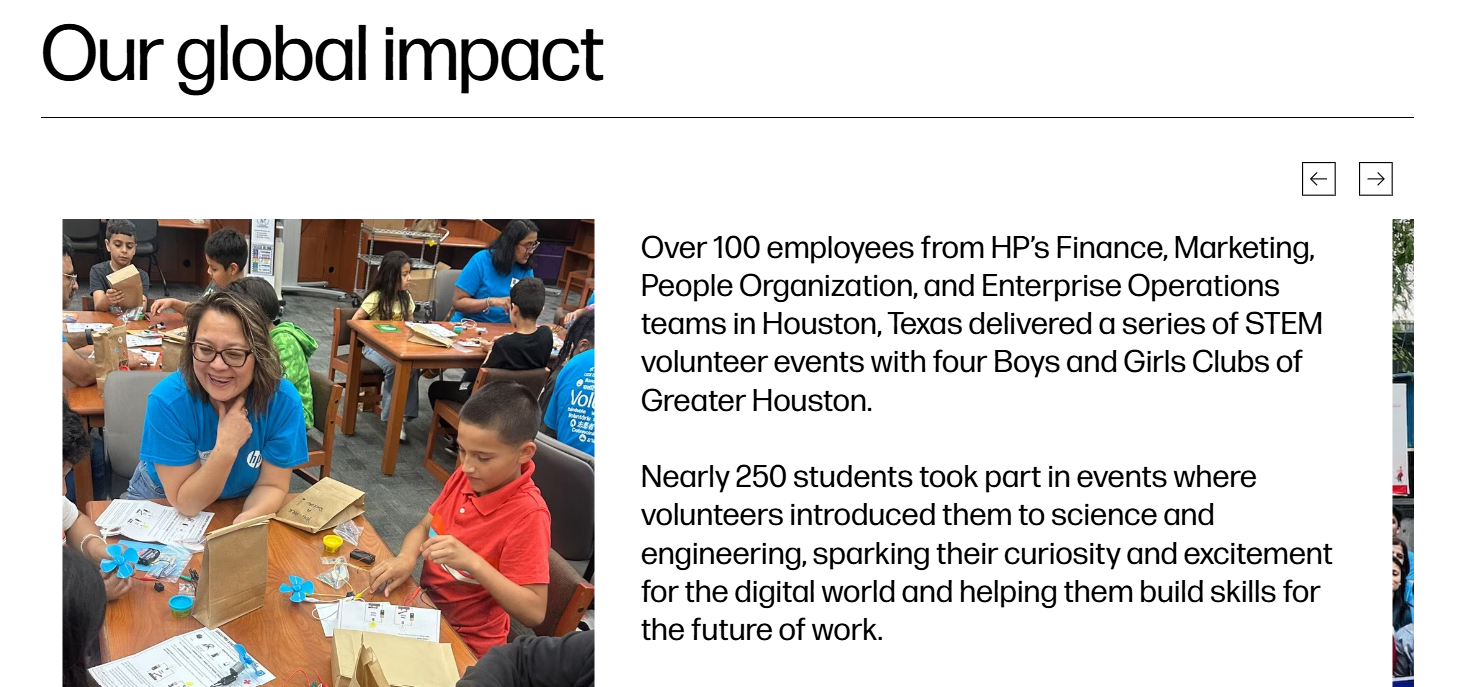
Get inspired by the HP Foundation’s volunteer programs and their emphasis on skills-based work.
Optimizing Payroll Giving: Securing Predictable, Recurring Revenue
Automated payroll deductions allow corporate employees to set up recurring donations to be taken directly from their regular paychecks. Because these gifts are deducted automatically before the employee even sees their net pay, they boast incredibly high donor retention rates.
However, a passive recipient simply waits to see if an employer's automatic check arrives in the mail. An active strategist proactively promotes payroll giving as a frictionless, high-impact way for supporters to sustain their mission year-round.
For example, active strategists may include simple payroll giving mentions into their ongoing communications, such as:
“Does your employer offer payroll deductions? Click here to learn how you can give to us directly through your paycheck.”
The Strategic Advantage of Payroll Deductions
Many donors want to make a larger financial impact but are hesitant to write a single, lump-sum check. Payroll giving solves this friction point by allowing donors to “break up” their target annual contribution into manageable, bite-sized amounts.
- The Micro-Gift, Macro-Impact Shift: A donor might hesitate to give $100 a month on their personal credit card. However, agreeing to a deduction of $25 per weekly paycheck feels completely manageable, while still securing highly predictable annual revenue for your organization.
- Pre-Tax Incentives: In many corporate structures, payroll giving can be processed as a pre-tax deduction, reducing the employee's taxable income right on their W-2. Actively reminding corporate donors of this benefit is an incredible incentive to get more deeply involved.
Step-by-Step Strategy: How to Promote Payroll Giving
Because you do not manage a corporation's internal payroll software, your job as an active strategist is to make it incredibly easy for employees to initiate the deduction on their own. Here are three targeted payroll giving marketing techniques that can help:
1. The “Alternative Giving” Page on Your Site
Donors cannot choose an option they do not know exists. On your website’s Ways to Give page, make sure to list payroll giving and make it incredibly easy for donors to discover their eligibility. An integrated company search tool like Double the Donation can help here, too!
2. Target Your Corporate Alumni and Major Employer Clusters
Analyze your CRM to find clusters of existing donors who work for the same corporate partners. Send a targeted outreach campaign to these segments explaining that your organization is already a verified, eligible 501(c)(3) choice in their company’s internal CSR system.
3. Partner with Employee Resource Groups (ERGs)
Proactively reach out to internal corporate groups (such as a “Women in Tech” or “Green Team” ERG) at a major local company. Offer them a turnkey seasonal giving campaign in which their members can collectively sign up for recurring payroll giving to support a specific project, enabling the corporation to track their shared community impact.
Understanding Corporate Vetting and Compliance
Before releasing employee matching gifts or volunteer grants, corporate platforms run a vetting process to ensure your nonprofit aligns with their pre-established guidelines. This typically includes…
- Policy Alignment: Some corporations may have specific exclusion policies regarding religious or non-secular programming. Proactively review platform guidelines if your organization serves a specific niche.
- Domestic Standing: Verification that your organization is an active, IRS-approved 501(c)(3) public charity or eligible school in good standing.
- International Equivalency: If your U.S.-based nonprofit operates programs abroad, corporate partners may require an Equivalency Determination (ED) to prove your work complies with U.S. charitable standards.
How to Process and Track Bulk Corporate Checks
When your marketing works and supporters begin engaging with corporate giving programs, funds will start rolling in. However, this success introduces a major operational hurdle known as the “mystery check” problem that comes with workplace gift disbursements.
What is a mystery check? A mystery check occurs when a CSR portal batches multiple employees’ contributions (including matching gifts, volunteer grants, payroll deductions, and corporate incentive credits) into a single, bulk disbursement check or deposit. When this money arrives without any additional context attached, individual contribution data is easily lost. And that makes it increasingly difficult to ensure every donor and volunteer is correctly identified and celebrated for their specific impact.
While a passive recipient simply cashes the check and moves on, an active strategist implements a clear, three-step operational workflow to “close the loop.”
Accessing CSR Portal Disbursement Reports
Assign a specific team member to log into your claimed CSR portals (such as Benevity and YourCause NPOconnect) on a fixed schedule. (For example, you might select the 15th of every month. From there, download the latest “Payment History” or disbursement reports. These files contain the exact details required to identify who influenced the funds:
- The names and emails of individual donors who requested a financial match.
- The names of volunteers whose logged service hours triggered a corporate volunteer grant.
- The itemized breakdown of recurring workplace payroll deductions.
CRM Integration and Employer Tracking
The “Soft Credit” Strategy
Your CRM should track the difference between the entity that legally signed the check (the company) and the individual who motivated it (the original supporter). To keep your data accurate, use this simple credit framework:
- Hard Credit: Assign this to the actual corporate entity that issued the financial payment. This ensures your legal accounting records match your bank deposits.
- Soft Credit: Apply this to the influencer (the employee, donor, or volunteer). For example, if a volunteer logs enough hours to trigger a $500 volunteer grant, their personal profile should reflect a soft credit of $500 to demonstrate their true value to your mission.
Preventing the Data Mess Before It Starts: The most effective way to eliminate the mystery check problem is to ask the right question at the very beginning of the supporter journey. By using automated communication streams that immediately prompt donors and volunteers to identify their employer, you can capture workplace affiliations at the point of highest intent.
Fun fact! Organizations that capture this data early have seen employer identification rates increase by up to 5x. This drastically reduces the need for backend research when the check finally arrives.
Compliance and Platform Roadblocks: Avoiding Workplace Giving Pitfalls
Workplace giving is a highly regulated environment where being “invisible” to corporate tracking software is the single greatest risk to your revenue. A passive recipient assumes that the money will naturally appear. However, an active strategist knows how to navigate platform minimums, anti-fraud guidelines, and complex tax-receipting rules to secure every dollar coming their way.
1. The Disbursement Trap: Why “Approved” Doesn't Mean “Paid”
Even after a corporation approves an employee's matching gift or volunteer grant, the actual cash can be held up by CSR portal disbursement minimums.
- The Threshold Rule: Most corporate giving platforms maintain minimum disbursement thresholds, often ranging from $25 to $100. If your organization's total accumulated funding for that specific portal falls below the threshold, the platform will hold the money until future employee gifts push you over the line.
- The Escheatment Risk: If an organization relies on physical mail, uncashed corporate checks can eventually be escheated (turned over) to the state government. Reclaiming these funds from the state is a massive administrative headache that can be entirely avoided with proactive, upfront setup.
- The Proactive Solution: Prioritize setting up Electronic Fund Transfers (EFT) across every CSR platform you claim. Direct deposit bypasses physical mailroom delays and frequently carries lower disbursement thresholds than paper checks. Plus, organizations often receive additional donor insights this way!
2. The Legal Donor of Record: Who Gets the Tax Receipt?
Maintaining proper tax-receipting compliance is essential for protecting your donor relationships and staying aligned with IRS guidelines. To avoid legal errors, your operations team must apply specific rules based on how the workplace funds were collected:
- Payroll Deductions: When an employee gives via automated payroll deductions, do not send them a tax receipt. Their corporate pay stub or the annual statement provided by their employer's CSR portal serves as their official, legal IRS record. Sending a duplicate receipt can lead to accidental double-deductions.
- Corporate Matching Funds: When a corporate matching check arrives, the corporation is the official “Donor of Record” for that specific transaction. The tax receipt must be issued to the business entity, not the individual supporter.
- Proactive Stewardship: While you must not send a tax receipt to an individual for their company's match, an active strategist always sends a personalized thank-you note. This acknowledges the employee's role as the influencer who successfully unlocked those corporate funds for your mission.
Keep in mind that while workplace giving participants are not the legal contributors of said corporate funds, they can and should be tied to the payment via a soft credit.
Reporting and Scaling: Tracking Metrics for Program Growth
To truly scale a comprehensive workplace giving program, your organization must shift from only tracking total revenue to analyzing the gap between what your donor base is eligible for and what has actually been claimed.
By establishing clear performance metrics and utilizing specialized fundraising tools, even a one-person development shop can proactively manage a high-volume workplace giving program.
KPIs for the Board: Demonstrating Your Active Strategy
When reporting progress to your leadership team or board of directors, look beyond basic bottom-line numbers. Proactively track and present these key performance indicators (KPIs) to demonstrate your growth:
Key Performance Indicator
Definition & Purpose
By highlighting the relationship between these two metrics, you can show leadership exactly how much money is being successfully captured (and how much is slipping through the cracks) to justify any future investments in database or automation tools.
Automation: Scaling Growth Without Adding Headcount
The most effective way for a lean fundraising team to become an active strategist is to let specialized software do the heavy lifting. Automated tools serve as a 24/7 team member, running your entire workplace giving program in the background:
- Upfront Search Integrations: Embeddable lookup tools capture employee data right at the moment of donation or volunteer sign-up, instantly mapping out their corporate eligibility.
- Automated Email Follow-Ups: Dedicated software automatically triggers the exact submission forms and links required based on the supporter's employer, ensuring you never miss the 24-hour high-intent window.
- The Scale Strategy: By shifting the identification and reminder tasks to automation, your staff avoids manual data entry and research. This allows your internal team to focus exclusively on high-level strategy and final payment reconciliation when the portal checks arrive. It gives a single development officer the infrastructure to run a massive, enterprise-sized workplace giving pipeline.
Here’s what the Florida Tech team shared in a recent summit discussion about demonstrating the ROI of workplace giving:
“Doing the bare minimum with automation will quickly generate enough new revenue to prove the program pays for itself. You can then use those tangible results to build a business case for hiring additional staff.”
The 90-Day Action Plan: Building Your Workplace Giving Engine
Transforming your organization’s workplace giving strategy doesn’t happen overnight, but it can happen in a single quarter. By dividing your implementation into a structured, 90-day sprint, you can establish a sustainable workplace giving system without overwhelming your internal resources.
The Data Audit (Lay the Foundation)
The goal of your first 30 days is to proactively uncover the hidden corporate giving potential already sitting inside your donor database and volunteer records.
The Marketing Launch (Turn on the Lights)
The second month is about making workplace giving options highly visible across all your active digital touchpoints.
The Stewardship Loop (Sustain the Growth)
Your final 30 days are focused on establishing a regular operational routine and celebrating the collective impact of your supporters' workplace engagement.
Next Steps: Closing the Underutilization Gap
Workplace giving is an incredible, streamlined mechanism for community impact amplification. The key to capturing your share of the billions of dollars left on the table every year? Consistency. By building a system that regularly identifies, invites, and integrates these opportunities into your organizational DNA, you move permanently into the role of an active fundraising strategist.
Deepen Your Workplace Strategy
Ready to take your workplace giving strategy to the next level?